

Three coordinated moves that displace cost — and pay for themselves
Match each Eskom tariff problem with the right technology: a Displacement PV array for the Standard period, a BESS for the Peak period, and a second Extra PV array that sells to the grid to offset the battery’s monthly cost. The BESS can target all Peak hours (Scenario B) or just the Evening Peak (Scenario C).
Displace expensive Standard energy
A 28.8 MWp PV plant generates all Standard-period energy currently bought from Eskom — supplied at R1.25/kWh instead of Eskom's R1.51–R1.62/kWh.
Displace Peak energy with BESS
A 126.5 MWh / 18.5 MW battery charges during cheap Off-Peak hours and discharges through the costly Peak window — replacing the R6.47/kWh tariff entirely.
A second PV array purely to sell
A dedicated Extra PV array (683.1 MWp in Scenario B) sells surplus to the grid at R1.48/kWh. The R0.23/kWh net margin fully settles the monthly BESS lease — so the municipality keeps 100% of the arbitrage savings.
How the BESS arbitrage works
Buy energy when it is cheap, deliver it when it is expensive — turning Eskom's own tariff structure into a saving.
Charge Off-Peak
22:00–06:00 at R1.079/kWh
Store in BESS
126.5 MWh, 90% round-trip efficiency
Discharge at Peak
Replaces R6.47/kWh Eskom tariff
The effective cost of Peak energy drops from up to R6.47/kWh to roughly R2.28/kWh — the Off-Peak charging cost including efficiency losses.
How the BESS pays for itself
The monthly battery lease is ring-fenced and settled entirely by dedicated extra PV — it never appears in the operational savings.
Extra PV generates surplus
Dedicated capacity beyond Standard displacement
Sell to the grid
R1.48/kWh sell-back, R0.23/kWh net margin
Settle the BESS lease
R155,000/MWh/month fully covered
The detailed design — Scenarios A, B & C
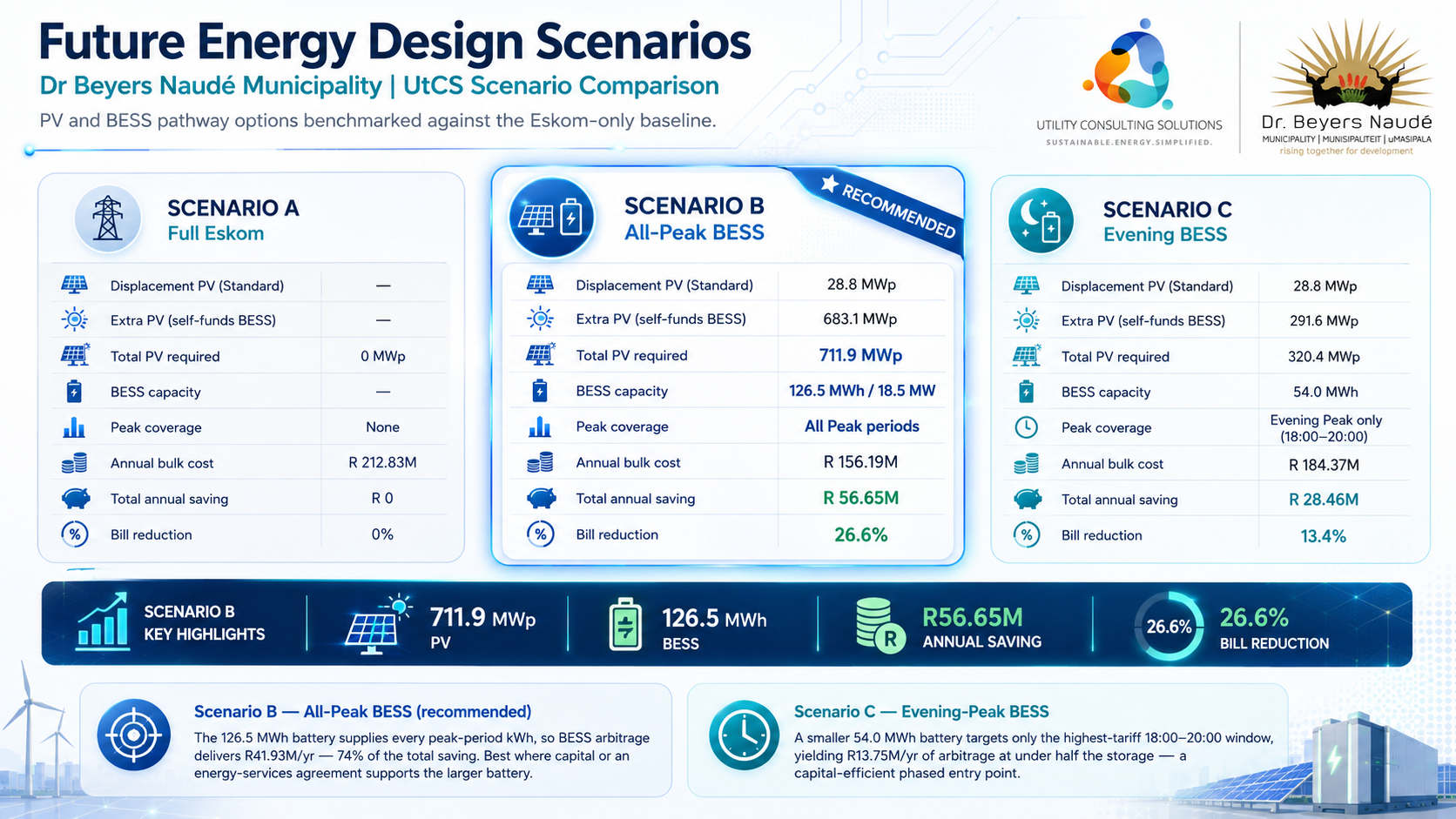
The same Displacement + Extra PV arrangement, paired with a BESS sized for either all Peak hours (B) or the Evening Peak only (C), benchmarked against the Eskom-only baseline (A).
| Design parameter | Scenario AFull Eskom | Scenario BAll-Peak BESS | Scenario CEvening BESS |
|---|---|---|---|
| Displacement PV (Standard) | — | 28.8 MWp | 28.8 MWp |
| Extra PV (self-funds BESS) | — | 683.1 MWp | 291.6 MWp |
| Total PV required | 0 MWp | 711.9 MWp | 320.4 MWp |
| BESS capacity | — | 126.5 MWh / 18.5 MW | 54.0 MWh |
| Peak coverage | None | All Peak periods | Evening Peak only (18:00–20:00) |
| Annual bulk cost | R 212.83M | R 156.19M | R 184.37M |
| Total annual saving | R 0 | R 56.65M | R 28.46M |
| Bill reduction | 0% | 26.6% | 13.4% |
Scenario B — All-Peak BESS (recommended)
The 126.5 MWh battery supplies every Peak-period kWh, so BESS arbitrage delivers R41.93M/yr — 74% of the total saving. Best where capital or an energy-services agreement supports the larger battery.
Scenario C — Evening-Peak BESS
A smaller 54.0 MWh battery targets only the highest-tariff 18:00–20:00 window, yielding R13.75M/yr of arbitrage at under half the storage — a capital-efficient phased entry point.
Scenario comparison at a glance
The full design comparison, summarised in a single visual benchmarked against the Eskom-only baseline.
The financial result
Annual bulk electricity cost by scenario
Eskom-only baseline (A) vs. Evening-Peak BESS (C) vs. full All-Peak BESS (B), in R millions/yr.
PV vs. BESS saving — B and C compared
Annual operational saving split by technology for each BESS strategy (R millions/yr).